

Eleven independent studies. 1.25 million classified tasks. One uncomfortable truth: enterprises are not failing at AI because the technology doesn’t work. They’re failing because nobody mapped the work before deploying it. Here’s what the data actually says and what to do about it.
Somewhere in your organisation right now, someone is sitting in front of a dashboard that shows AI tool adoption at 60 percent. Usage metrics are green. The quarterly slide looks good. And yet when you ask where the productivity actually went where the hours are being reclaimed, where the cost is actually moving the answer is a shrug.
This is not an unusual situation. It is, in fact, the most common one. Andreessen Horowitz analysed Fortune 500 AI adoption and found that 29 percent of companies are now live, paying AI customers – a historically unprecedented adoption rate. But adoption and value are not the same thing. According to McKinsey, only 15 percent of enterprises have seen meaningful financial impact. The gap between those two numbers is where most organisations currently live.
When Nuvepro analysed 1.25 million tasks across industries, roles, and workflows, a picture emerged that explains both why AI ROI is so hard to find and exactly what it takes to capture it. This is what the data shows.
“Enterprises have the tools. They skipped the work redesign. That single omission is behind 88% of AI pilots that never reach production.”
The numbers that explain why AI ROI keeps disappearing
Start with a study from OpenAI researchers who mapped how AI affects the U.S. labour market at the task level. Their finding was precise and, for most organisations, quietly devastating.
OpenAI – ‘GPTs are GPTs’ Study, August 2023
80% of workers have at least 10% of their tasks exposed to AI. But AI models alone speed up only 15% of those tasks. When organisations build systems around the models, that number jumps to 56%. The 41-point gap between 15% and 56% is the system integration work that almost every enterprise skips.
Read that again. AI tools, on their own, accelerate 15 percent of tasks. With the right system built around them meaning tasks have been classified, agents have been assigned, handoffs have been defined, and people have been prepared that becomes 56 percent. The tools are not the constraint. The system design around them is.
Anthropic’s 2026 research confirmed this from a different angle. Measuring AI task coverage across the US economy, they found that 94 percent of occupations have at least one task that AI can handle today. But only 33 percent of tasks are actually being done by AI. That 61-point gap exists for one reason: organisations deployed the technology without redesigning the work around it.
94%
of occupations have at least one AI-coverable task (Anthropic, 2026)
33%
of tasks are actually being done by AI today
61 pts
gap – the work redesign most enterprises skipped
80%
of AI projects fail entirely (RAND Corporation)
And then there is the production problem. IDC found that 88 percent of AI pilots never reach production. Not because the pilot failed because nobody built the operational layer around it. Who supervises the agent? What happens when it produces a wrong answer? How does the handoff work? These are not technical questions. They are task-level questions. And without a Task Intelligence framework to answer them, pilots stay pilots.
Why giving people AI tools is not the same as using AI
There is a version of AI adoption that looks like progress and produces almost none. It goes like this: leadership buys Copilot licences or subscribes to an AI platform. Rollout happens. Usage metrics climb. And then nothing structurally changes about how work flows, how long tasks take, or what the output looks like.
Guild Education surveyed 355 workers to understand why this happens. What they found was a trust and readiness crisis, not a technology problem.
Guild Education – AI Training Study, December 2023
88% of workers don’t trust their employer to prepare them for AI. Only 36% of frontline employees have received any enterprise AI training programs at all compared to 44% of leaders. The gap is widest for the people actually doing the work.
Think about what that means in practice. You deploy an AI tool to a team. Nearly nine in ten of them do not believe their employer will help them use it effectively. So they use it cautiously, for low-stakes tasks, in ways that don’t fundamentally change how the work gets done. Adoption is high. Impact is minimal. The metric and the reality point in opposite directions.
The Everest Group surveyed enterprise learning leaders and found the infrastructure for closing this gap is almost entirely absent. Only 25 percent of enterprises have virtual hands on labs or GenAI Sandbox environments where people can actually practise. Only 18 percent have skills management platforms. And only 43 percent have any way to measure whether their enterprise AI training programs worked at all.
The problem is not that people can’t learn. The problem is that most generative AI training for employees happens in slide decks, without the hands-on practice that turns knowledge into a change in how work actually gets done.
This is precisely what Nuvepro’s AI Bootcamp was built to address. It doesn’t teach AI in the abstract. It starts with the task classification for a specific role, builds training scenarios around the actual tasks that are changing, and measures readiness against the work not a generic test. People finish knowing what to do because they have already practised it.
What 1.25 million tasks actually look like
When Nuvepro's Task Intelligence platform classified tasks across industries, roles, and workflows, a pattern emerged with remarkable consistency. It held in financial services. It held in healthcare. It held in manufacturing and technology. Regardless of industry, the distribution looked roughly the same.
30%
AUTOMATE
AI owns end-to-end. Data checks, format matching, routine reports, scheduling. Agents do this faster and without fatigue.
40%
AUGMENT
Human + AI together. AI does 70–80% of the legwork. The person reviews, adjusts, and makes the call. Largest bucket, most value.
30%
HUMAN ONLY
Conversations that need reading the room. Ethical calls. Relationships built on trust and history. These tasks stay human always.
The 30/40/30 split is not a prediction. It is a finding from 1.25 million classified tasks across real jobs and real workflows. And it has an important implication: the largest bucket – the 40 percent where human and AI work together is where most of the value from AI actually comes from. Not full automation. Augmentation.
MIT Noy and Zhang (2023) confirmed this in a controlled study: on tasks where AI assisted human judgment rather than replacing it, professionals saw 40 percent time savings and 18 percent improvement in output quality. The gains did not come from removing the human. They came from changing what the human spent their time on.
But here is where partial automation creates a trap. Andreessen Horowitz found that when AI handles 50 percent of tasks in a role, the remaining 50 percent do not simply continue as before – they become bottlenecks. They increase in relative importance and become the constraint on the entire system. One percent more AI capability does not translate to one percent more value. Without task-level classification mapping where value is created and where it is blocked, enterprises cannot see this dynamic until it has already slowed them down.
“Automating 50% of tasks does not deliver 50% of the value. The remaining tasks become the bottleneck. Task Intelligence is what tells you which 50% to start with.”
The production gap: where AI investment goes to die
The numbers on AI project failure are stark and well-documented. They point to a single root cause.
CIOs who skip these questions do not just misallocate capital. They automate the visible work and lose the valuable work. The organizations that ask them with task-level data in hand are the ones that show up to board meetings with defensible numbers rather than vendor slide decks.
80%
of AI projects fail (RAND Corporation)
88%
of pilots never reach production (IDC Research)
15%
have seen meaningful EBIT impact (McKinsey – of all enterprises)
A cross-industry analysis from 2026 found the reason behind these numbers: 70 percent of AI project budgets go to models and tools. The remaining 30 percent is supposed to cover data governance, security, workforce preparation, and work redesign. It never does.
The same analysis found a striking contrast in returns: replacing workers with AI yields 0 to 23 percent improvement. Augmenting workers with AI – the model where humans and agents work together yields 200 to 500 times improvement. True convergence, where AI and operations integrate at the task level, yields 2,000 times. The ROI is not in the tool. It is in the design of how the tool sits inside the work.
WEF Future of Jobs Report – February 2026
92 million jobs will be eliminated by 2030. But 170 million new roles will be created- a net gain of 78 million. Organisations investing in workforce development are 1.8x more likely to report better financial results. The gain is not automatic. It requires intentional investment across five pillars: Vision, Skills, Technology, Process, and Culture.
The Cognizant / Oxford Economics model, which analysed 18,000 tasks across 1,000 jobs, reached the same conclusion from a different angle: generative AI could inject up to $1 trillion in annual GDP by 2032, but outcomes range from $477 billion to $1 trillion depending entirely on how organisations invest in preparing their people. The technology determines the ceiling. The work redesign determines what you actually reach.
How to become an agentic organisation: the 14-day model
Becoming an agentic organisation does not start with buying more tools. It starts with mapping the work. Here is how Nuvepro does it and why it produces a working system in 14 days rather than a deck.
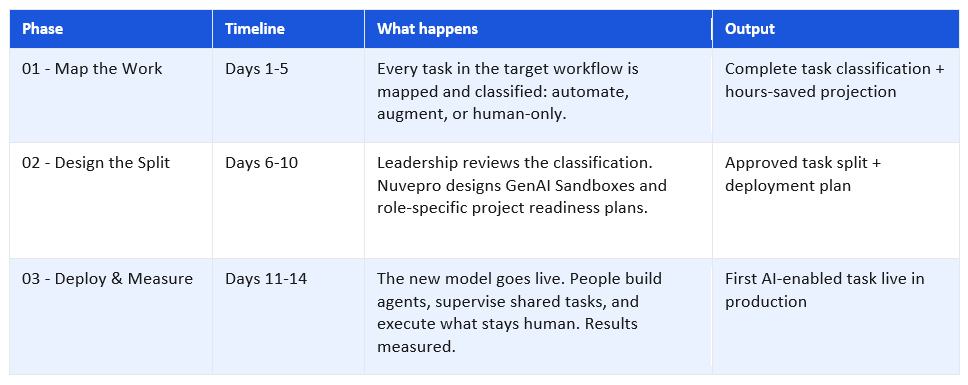
This model works because it operates at the task level, not the job level. A job title is too coarse for AI planning. When you decompose a role into its 15 to 40 individual tasks and classify each one, you surface decisions that job-level thinking misses entirely: which tasks teach skills people need five years from now? Which tasks, if automated, create bottlenecks elsewhere in the workflow? Which tasks look mechanical but are actually how institutional knowledge gets built and transferred?
The four things that make this different from generic AI training
GenAI Sandbox environments. Pre-configured sandbox environments where people build, test, and iterate agents on realistic data and real workflow scenarios. No setup required. No waiting for IT.
Workflow-grounded simulations. Agent development challenges built backward from your actual workflows – customer service bots on your data patterns, document analysis on your document types, multi-agent systems designed around your actual process.
Role-specific project readiness bundles. Not generic AI awareness content. Curated learning paths mapped to the specific tasks that are changing in each role, with competency targets tied to the new work split.
EASE assessments. Validation that goes beyond completion rates. People are assessed against real task performance – not a certificate that says they attended. Project-readiness is a measurable bar, not a feeling.
MIT Sloan found that organisations involving workers in AI implementation decisions are 16 percent more productive than those that impose AI top-down. Nuvepro’s Task Intelligence audit starts with what workers actually do – building the system from the work up, not the tool down.
The question nobody is asking about AI ROI
The Economic Policy Institute has tracked productivity and pay in the US economy since 1979. In that time, productivity grew 92.4 percent. Typical worker pay grew 33.6 percent. The two metrics that used to move together have diverged almost entirely. When AI drives the next productivity surge – Goldman Sachs estimates a 15 percent labour productivity boost at full adoption – the question is not whether productivity increases. It is who captures the value.
This matters for enterprise AI ROI more than it might seem. MIT Sloan found that organisations are 16 percent more productive when they involve workers in AI implementation. That is not a political finding – it is an operational one. Workers know where the edge cases are. They know what the data looks like when it is messy. They know which steps in a workflow are the ones that actually go wrong. Generic agents fail on this. Workflow-grounded agents built with worker input do not.
Training workers to build and supervise agents through Nuvepro’s AI Bootcamp is how the productivity value reaches the people doing the work. And it is also how you get agents that are reliable enough to actually change how the work flows.
What the data is actually telling you
Eleven independent studies, 1.25 million classified tasks, and the same conclusion from every direction: the ROI from AI does not come from the tool. It comes from the redesign of work around the tool - task by task, role by role, workflow by workflow.
The organisations that are pulling ahead are not the ones that bought the most AI licences. They are the ones that used Task Intelligence to map exactly which tasks AI should own, which tasks humans and AI should share, and which tasks must stay human. Then they built the agents. Then they prepared their people. Then they shipped the redesign to production.
The 61-point gap between what AI could do and what it is actually doing in most enterprises is not a technology problem. It is a work design problem. And it is entirely fixable – one workflow at a time.
Start Your Task Intelligence Audit
Nuvepro has classified 2.1 million tasks across 81 industries. In 14 days, we classify every task in one workflow, define the human-AI split, get your team building agents in GenAI Sandboxes and ship the first AI-enabled task to production. Not a deck. A working system.