

AI Bootcamps are rapidly becoming the go-to solution for organizations serious about building real workforce capability, not just awareness, around artificial intelligence. Unlike traditional online courses or passive training programs, AI Bootcamps for enterprises are intensive, skills-focused programs that teach AI, machine learning, and generative AI through hands-on projects grounded in your actual workflows. And as more companies discover the difference between having AI tools and being a truly AI-enabled organization, demand for AI Bootcamps has surged across every major industry.
Whether you are in financial services, healthcare, manufacturing, or professional services, the question is no longer if your team needs to work with AI. It is how fast you can get them genuinely ready to do so. That is exactly the gap that AI Bootcamps for enterprises are designed to close: not with slide decks or certification badges, but with real workflow transformation, measurable productivity gains, and a team that can operate independently in the new model.
The organizations pulling ahead right now are not the ones that bought the most AI licenses. They are the ones that figured out which work AI should own, which work humans and AI should do together, and which work stays firmly in human hands. That clarity does not come from a webinar. It comes from structured, task-level training built around your specific workflows. That is the promise of a well-designed AI Bootcamp for enterprises, and it is why enterprise investment in this category is accelerating fast.
Why Enterprises Are Moving Beyond Traditional AI Training
Most enterprise AI initiatives stall for a simple reason: they deploy tools to job titles instead of tasks. A Financial Analyst at one company may do 35 different tasks, while the same title at another company does 22 completely different ones. Generic AI training cannot account for that variation, and neither can most online courses.
Research backs this up. Frey and Osborne established back in 2013 that automation analysis must happen at the task level, not the job level. A landmark Harvard and BCG study found that professionals using AI improved performance 12 to 40 percent on tasks inside AI’s capability frontier, but performed 19 percentage points worse on tasks outside it. The takeaway is clear: knowing which tasks AI should handle, and training your team accordingly, is the difference between measurable gains and expensive mistakes.
A 2026 randomized controlled trial by Kim at INSEAD tracked 515 startups and found that organizations that did structured task mapping before deploying AI generated 1.9x more revenue and identified 44 percent more AI use cases than those that simply gave their teams tool access. The mapping drives the result. Tool access alone is not enough.
That is the foundation of a well-designed AI Bootcamp: not generic AI literacy, but task-level precision applied to your specific workflows. The best enterprise AI training programs do not start with tools. They start with a rigorous audit of what your team actually does, and build the training around that reality.
What Makes an Enterprise AI Bootcamp Different
Hands-On, Not Hypothetical
The most important distinction between AI Bootcamps and conventional training is what participants actually do. In a quality enterprise bootcamp, your team is not watching demos or completing quizzes. They are building the actual workflow that will go live in production.
At Nuvepro, this happens through Simulations: 4-hour guided exercises built on your real workflow data, run inside GenAI Sandboxes that mirror your production environment. Each simulation has a concrete deliverable, not a participation certificate. Your team walks out having configured the agent, tested it against real data, and proven they can operate it independently.
Each task in the bootcamp follows a three-simulation plus one assessment structure:
- Sim 1: Build the core workflow. Configure the agent, test it, see it work.
- Sim 2: Integrate and connect. Wire to real systems, data sources, APIs, and triggers.
- Sim 3: Stress the handoffs. Edge cases, escalation protocols, manager supervision practice.
- Assessment: Prove readiness. An independent exercise. Pass equals project-ready.
This structure means participants come out having done the work, not just learned about it. That distinction matters enormously when you are trying to move from pilot to production.
Built Around Task Intelligence
The best enterprise AI training programs do not start with tools. They start with a workflow audit. Before anything gets built, the highest-impact tasks are identified and classified into three categories:
- Automate (approximately 30%): AI handles end-to-end tasks like invoice processing, data entry, and routine reporting. Deploy agents here first.
- Augment (approximately 40%): Human and AI working together. The largest bucket, and where most of the value lives. AI handles 70 to 80 percent of the work while humans provide judgment and accountability.
- Human-Only (approximately 30%): Empathy, negotiation, ethical reasoning, creative synthesis, and physical presence. This work should be protected and invested in.
This classification is drawn from the analysis of 2.1 million tasks across 2,400 companies and six industries. It means your team’s AI training with hands-on labs is targeted at the right tasks, not a generic curriculum. Nuvepro’s AI Bootcamp uses exactly this methodology, ensuring every sprint is grounded in your organization’s actual workflow data.
Tool-Agnostic by Design
One of the most practical features of a well-run enterprise AI bootcamp is that it is not tied to a single vendor. Whether your organization uses OpenAI, Anthropic Claude, Google Gemini, Microsoft Copilot, or an industry-specific AI platform, the bootcamp works with your existing stack. The simulations are built in GenAI Sandboxes that mirror your production environment, which means the workflows your team builds during training are the same ones they will run in production after it.
The Agentic Organization: What You Are Building Toward
The end goal of enterprise AI training is not a team that knows about AI. It is a team that can operate in an AI-enabled model, what is increasingly called an agentic organization.
An agentic organization is one where AI agents handle the tasks best suited to automation, human-AI collaboration is designed intentionally at the handoff points, employees can supervise and validate AI outputs rather than just consume them, and leadership has task-level data to measure the financial impact of every workflow change.
Becoming an agentic organization does not happen through a one-time training event. It happens through a structured process: audit, classify, build, assess, and repeat across the workflows that matter most to your business. That is the architecture a well-structured AI Bootcamp should follow, and it is what separates genuine transformation from another round of AI awareness training that changes nothing.
The research on this is unambiguous. Organizations that approach AI deployment as a workflow redesign challenge, rather than a technology adoption challenge, consistently outperform those that do not. They see faster task completion, higher output quality, and measurable financial returns that they can actually show a board.
Enterprise AI Bootcamp Formats: What to Expect
The 14-Day Pilot
The fastest way to prove the model works. One task, up to five people, 16 hours of guided instruction across four sessions. The output is a working AI-enabled workflow, a balance sheet proof of impact, and a blueprint for scaling.
This is the entry point for most enterprise teams. It is low-risk, fast, and produces something real. Rather than commissioning a strategy report on AI readiness, you run one task through the full bootcamp process and come out the other side with a working workflow and the financial data to justify expanding it. Most organizations that run a 14-day pilot go on to the Sprint.
The 6 to 8 Week Sprint
The full transformation. Three tasks, up to 15 people, 64 hours of AI training with hands-on labs for enterprises across all three workflows. Participants complete 9 simulations and 3 independent assessments, and come out with handoff protocols and team-wide readiness across the selected workflows.
This is the format for organizations ready to genuinely transform a business unit, not just run a proof of concept. By the end of the Sprint, you have redesigned three workflows, trained the team to operate them, and have the data to measure the before-and-after impact on productivity and cost.
Enterprise Custom
For organizations deploying AI Bootcamps for enterprises across multiple workflows and departments. This includes a dedicated program manager, ongoing coaching, executive readiness briefings, and custom timelines. This is where becoming an agentic organization moves from aspiration to operating model. Multiple workflows are transformed across departments, with consistent methodology and measurable outcomes at every stage.
Who Is This For?
One of the most common misconceptions about enterprise AI bootcamps is that they are designed for technical teams. They are not, or at least the best ones are not.
The simulations and assessments in a well-designed bootcamp are built for the people who already understand the work: the claims processor, the manufacturing engineer, the financial analyst, the operations manager. They do not need to code. The technical setup is handled by the Nuvepro AI Specialist who leads each session. What they need is the ability to configure agents, validate outputs, handle edge cases, and supervise AI-assisted workflows. That is exactly what the bootcamp trains.
Two training tracks run in parallel in the best programs:
- Work with AI: Supervision, validation, and quality control of AI outputs. Learning to catch errors, manage edge cases, and maintain accountability over AI-generated work.
- Build with AI: Configuring agents, connecting systems, creating workflows. Learning to set up the tools, not just use them.
Both tracks are measured in outcomes that matter to the business: hours reclaimed per person, dollar impact per role calculated using Bureau of Labor Statistics wage data, and demonstrated readiness assessed independently at the end of each task sprint.
Generative AI Training for Employees: What the Research Says
The business case for generative AI training for employees is no longer speculative. A growing body of rigorous research now supports the financial argument for structured, task-level AI training over generic tool rollouts.
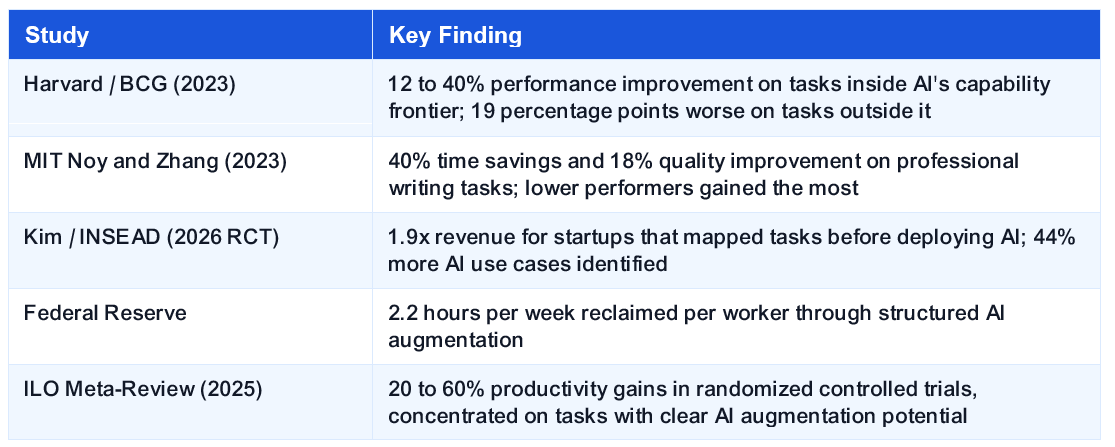
The consistent thread across all of this research is that task mapping before deployment drives the result. Organizations that understand which tasks sit inside AI’s capability frontier, and train their people specifically on those tasks, see returns that are multiples of those achieved through generic tool rollouts.
The Harvard and BCG finding is particularly important for enterprise leaders to internalize. The same AI tools that improved performance by up to 40% on the right tasks made performance measurably worse on the wrong ones. Without task-level training, you are rolling out tools that will simultaneously help and hurt your team, and you will not know which is which until the damage is done.
Three Questions Every Enterprise Should Ask Before Rolling Out AI
A task classified as automatable is not automatically a task that should be automated. Capability and necessity are not the same thing. Before your organization deploys AI against any workflow, three questions need honest answers.
What is the actual economic value of automating this task?
Not the theoretical value. The real value, accounting for transition costs, training costs, and the cost of managing the human impacts. A task that saves 200 hours per year might cost significantly more in change management. That math needs to be done before the decision is made.
What is the strategic cost of removing the human from this task?
Does this task teach people skills they will need later? Does it maintain a client relationship? Does it build institutional knowledge that lives nowhere else? If the answer to any of those questions is yes, you may choose not to automate even if the financial case looks compelling.
What happens to the person when this task is removed?
Are they elevated to more valuable work, or left doing fragmented, low-engagement tasks? Are they redeployed to something equally meaningful, or quietly managed out? The answer to this question determines whether automation creates organizational value or quietly destroys it.
A structured AI Bootcamp surfaces these questions at the right moment in the process, during the audit and classification phase, before anything gets built. That is when the answers are still actionable.
Is Your Organization Ready to Run an AI Bootcamp?
The answer is almost certainly yes. The question is which workflow to start with.
The Nuvepro AI Bootcamp starts with an audit of your existing workflows, classifies every task against current AI capability, and identifies the highest-impact starting point together with your leadership team. From there, your people build the actual workflow in 14 days.
A working AI-enabled workflow, built by your team, assessed independently, and ready for production. That is the standard a genuine enterprise AI bootcamp should be held to, and it is the standard that separates the organizations that are genuinely becoming agentic from the ones still stuck in the planning phase.