

42% of companies abandoned most of their AI initiatives in 2025, up from 17% the year before. A lot of that wreckage has a bootcamp sitting somewhere in its history. This is not an argument against hands-on AI training. It’s a look at why so much of it doesn’t work, and the handful of things that separate the AI Bootcamps that produce something real from the ones that produce a line item in next year’s write-off.
Somewhere around 2024, the AI Bootcamp became the reflexive answer to almost every capability gap an enterprise could name. Need your sales team using AI? Bootcamp. Worried engineering is behind? Bootcamp. Board asking what the AI strategy looks like? Roll out a bootcamp, report the completion numbers next quarter, move on.
It made sense at the time. Bootcamps were fast, relatively cheap, and easy to greenlight compared to a multi-year capability programme. For a while, that worked well enough that nobody questioned the model too closely.
Without that picture, everything else is guesswork. AI tools get deployed broadly, people use them for the easy or obvious things, and the rest of the work stays exactly as it was. A year later, leadership looks at adoption numbers and cannot understand why nothing has really changed.
Something has shifted since. Across a string of 2025 and 2026 studies, the evidence is mounting that the bootcamp-first instinct, buy a course, push it to everyone, report completion, is not just falling short. In a meaningful number of cases, it is actively making the underlying capability gap worse, because it lets leadership believe the problem is solved when it isn’t. Most of what got built in that rush was not a genuine enterprise AI training program. It was a procurement decision wearing a training costume.
This piece is not an argument against AI Bootcamps as a format. The hands-on, learn-by-doing model is genuinely the right instinct, and the research backs that up clearly. It’s an argument against the specific way most enterprises are currently running them, and a fairly concrete list of things worth checking before you sign off on the next one.
The bootcamp was never the problem. Optimising for completion instead of application was.
The numbers nobody puts on the bootcamp sales deck
Start with the scale of the problem, because it's larger than most people assume. MIT's NANDA initiative studied 300 public enterprise AI deployments in 2025 and found that only 5 percent of integrated pilots were producing measurable profit-and-loss impact. The rest were stuck, not failing dramatically, just quietly delivering nothing anyone could point to on a balance sheet.
That stalling pattern shows up everywhere you look for it. S&P Global Market Intelligence found that 42 percent of companies abandoned most of their AI initiatives in 2025, up sharply from 17 percent the year before. RAND’s broader analysis of AI project failure rates put the number above 80 percent, roughly twice the failure rate of comparable non-AI technology projects.
42%
of companies abandoned most AI initiatives in 2025, up from 17% in 2024 (S&P Global)
95%
of integrated AI pilots fail to produce measurable P&L impact (MIT NANDA, 2025)
85%
of workers in 2026 say they can’t connect AI training to their actual job (Docebo)
33%
of employees received any AI training at all in the past year, despite 94% of CEOs naming it a priority
That last figure is the one worth sitting with. Even where bootcamps and enterprise AI training programs did happen, most employees still can’t connect what they learned to what they actually do each day. Docebo’s 2026 research framed this as three walls between workers and useful AI skills: no protected time to practise, training disconnected from the systems people actually work in, and a persistent inability to apply what was covered. All three walls were built by the same management decision, move fast on the tools, slow on the people.
Docebo, 2026 Enterprise AI Skills Research Most corporate AI programs in 2026 were bought in a panic during 2024-2025, when boards started asking CEOs what their ‘AI strategy’ looked like. The fastest answer was a procurement decision: license a generic AI training catalog, push it to every employee, report a completion percentage to the board. The metric the company optimised for was completion, not application.
The five ways bootcamps quietly fail
Pull apart enough of these failed initiatives and the same handful of failure modes show up again and again. None of them are about the technology. All of them are about the design decisions made before the bootcamp ever started.
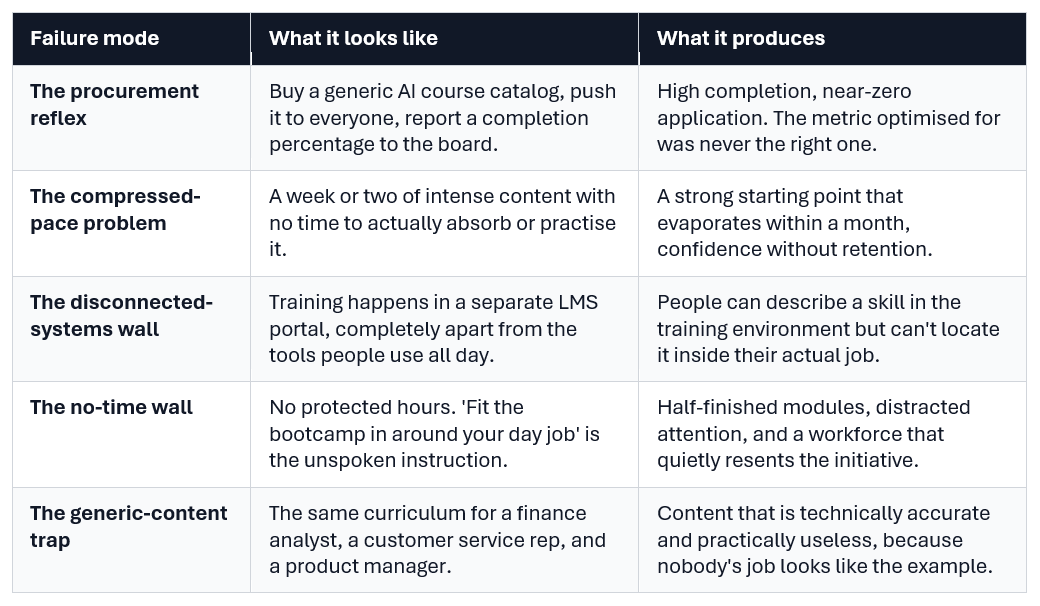
Look closely at that table and a pattern emerges: every single failure mode is a decision made before training began, not a flaw in the training itself. Nobody mapped which tasks actually needed to change. Nobody protected the time required to practise. Nobody built the content around the specific workflow a specific team operates. The bootcamp wasn’t broken, it was answering a question nobody had actually asked.
A bootcamp can have excellent instructors, slick simulations, and a generous budget, and still fail completely, if it was built before anyone understood which tasks in which workflow were supposed to change.
Why generic AI training stalls at the individual level
MIT's NANDA researchers made a distinction worth dwelling on. Generic AI tools, ChatGPT, Copilot, the consumer-facing assistants, succeed well at the individual level precisely because they're flexible. Someone can use them for almost anything, on their own initiative, without needing the tool to understand their specific job.
That same flexibility is exactly why they stall at the organisational level. A generic tool doesn’t learn the workflow. It doesn’t adapt to your specific process, your specific edge cases, your specific handoffs. So a bootcamp built around ‘here’s how to use this generic tool well’ produces individuals who are modestly more capable and an organisation that has not actually changed how its work flows. The result is not an agentic organization. It is a workforce with a new tab open.
This is the same root cause behind the resource misallocation MIT identified: more than half of generative AI budgets go toward sales and marketing tools, while the biggest measurable ROI sits in back-office workflow automation, the unglamorous stuff nobody puts in a keynote. AI Bootcamps inherit this same skew. They get built around the visible, exciting use cases instead of the actual highest-value tasks sitting inside a specific team’s workflow.
MIT NANDA, The GenAI Divide: State of AI in Business, 2025 Generic tools excel for individuals because of their flexibility, but they stall in enterprise use since they don’t learn from or adapt to workflows. Purchasing AI tools from specialised vendors and building close partnerships succeed about 67% of the time. Internal builds without that workflow grounding succeed only one-third as often.
The pace problem nobody wants to admit
There's a more uncomfortable critique surfacing in the corporate learning literature, and it deserves a fair hearing rather than a defensive dismissal. A widely cited 2025 review of bootcamp-style enterprise skill training programmes found a consistent participant complaint: not enough time to actually absorb or master the material. Compressed, intensive instruction creates a strong starting point. It does not, on its own, create durable expertise.
This matters because it cuts against a common assumption, that fast and hands-on automatically means effective. Fast is real. Hands-on is real. But if the pace is so compressed that nothing has time to actually settle into practice, you’ve built something that looks like capability-building and functions more like a very engaging demo.
The honest response to this critique is not to abandon the hands-on model, the evidence for learning-by-doing over passive content consumption is still strong. The honest response is to be far more disciplined about scope. A workforce training platform that tries to cover an entire department’s AI transformation in three days will hit this wall. A bootcamp built around one real workflow, with enough time to actually build, test, and stress the result inside a live GenAI sandbox training platform, generally won’t.
Compressed instruction can create a strong starting point without creating durable expertise. For organisations facing real capability gaps, the starting point is no longer enough.
What to actually check before you run one
None of this means hands-on AI training is the wrong instinct. The research consistently shows it beats passive, concept-based learning when it's built well. The question worth asking before signing off on the next AI Bootcamp for enterprises is not 'hands-on or not', it's whether the specific programme in front of you was designed to avoid the failure modes above.
Was the work mapped before the curriculum was written?
If the bootcamp content was built first and the question of ‘which tasks in this team’s workflow actually need to change’ came second, or never came at all, that’s the single biggest predictor of a stalled outcome. The audit has to come before the build, not as an afterthought. A genuine enterprise AI training program starts with a task map, not a course catalog.
Is it built on your real workflow, or a generic case study?
A simulation built on a hypothetical customer service scenario teaches a hypothetical skill. A simulation built on your team’s actual ticket queue, inside a sandbox environment platform that mirrors your production systems, teaches something that transfers the moment the bootcamp ends, because it was never separate from the job in the first place. That is the difference between generative AI training for employees and genuinely useful AI training with hands-on labs for enterprises.
Is there a real test at the end, or just a survey?
Completion rates and satisfaction surveys measure attendance and mood. They do not measure whether someone is project-ready: able to operate a redesigned workflow independently, without guidance. If the programme’s only proof of success is a feedback form, you don’t actually know if anything changed. Project readiness is the standard, independently demonstrated capability, not a certificate for showing up.
Is the scope one workflow, or everything at once?
The pace problem gets worse the more ground a bootcamp tries to cover. A tightly scoped sprint, one real workflow, enough time to build and stress-test it properly inside a live GenAI sandbox training platform, produces durable capability. A sprawling, department-wide rollout compressed into the same timeframe produces the starting-point problem the research keeps flagging.
Why the audit has to come first
This is, in a fairly direct way, the argument for doing the work, mapping the actual tasks in the actual workflow, before building any enterprise skill training around it. Not as a branding distinction, but because it's the step that's missing from most of the failed initiatives in the research above.
A bootcamp built without that audit is, structurally, a generic course wearing a hands-on costume. It might still beat a slide deck. It will not beat a bootcamp built on the specific tasks a specific team needs to change, validated against whether people can actually run the new workflow independently rather than just describe it. That independence is what project readiness actually means, and it’s the only outcome worth measuring.
This is the distinction Task Intelligence is built around: classify the real tasks first, automate, augment, or human-only, then build the simulation inside a GenAI sandbox training platform, then test for independent capability, not completion. It’s a more deliberate sequence than ‘buy the catalog, push it out, report the percentage.’ It’s also, based on everything above, the difference between joining the 5 percent and joining the 42 percent that walked away.
The organizations on the right side of that line are the ones becoming an agentic organization in the real sense of the phrase: AI agents owning the tasks best suited to automation, humans and AI working together on the tasks that need both, and a workforce training platform built around that classification, not around what was easiest to procure.
McKinsey, 2025 State of AI Survey Organisations reporting significant financial returns from AI are twice as likely to have redesigned end-to-end workflows before selecting any modeling or training approach. The sequence matters as much as the content.
The bootcamp isn't the problem. The shortcut is.
It's tempting to read the failure statistics and conclude that AI Bootcamps don't work. That's not quite what the evidence says. What it says is that a bootcamp optimised for completion, built on generic content, disconnected from the actual workflow, and squeezed into a timeframe too short to produce real retention, that specific combination doesn't work. Which describes a large share of what got built in the 2024-2025 rush.
The fix isn’t a different format. It’s a different sequence. Map the work first. Build the enterprise AI training program around the tasks that are actually changing. Test for project readiness, not attendance. Keep the scope tight enough that people have time to actually absorb what they’re practising inside a live sandbox environment platform.
Do that, and a bootcamp stops being a line item that gets quietly abandoned next year. It becomes the thing that actually moves a workflow from ‘we have AI tools’ to ‘this specific process runs differently now, and here’s the team that can prove it.’ That is what becoming an agentic organization looks like in practice, not a strategy deck, not a completion report, but a specific workflow that runs differently, built by your own people, and proven in production.
Before you run another bootcamp, map the work first.
The organizations on the right side of that line are the ones becoming an agentic organization in the real sense of the phrase: AI agents owning the tasks best suited to automation, humans and AI working together on the tasks that need both, and a workforce training platform built around that classification, not around what was easiest to procure.
Nuvepro starts every engagement with a Task Intelligence audit, not a curriculum. We classify the real tasks in your real workflow before anyone builds a single training module. That's the difference between a generative AI training for employees program that produces completion certificates and one that produces a working agent in production, with a team that is genuinely project-ready to operate it.
See how Task Intelligence changes this nuvepro.ai/task-intelligence
Research Referenced
MIT NANDA, ‘The GenAI Divide: State of AI in Business 2025’, 300 public AI deployments analysed
S&P Global Market Intelligence, 2025 Enterprise AI Survey, 1,000+ enterprises, North America & Europe
RAND Corporation, AI project failure rate analysis, 2025
Docebo, ‘2026 Enterprise AI Skills Research’, the ‘three walls’ framework
Training Industry, ‘Is the Bootcamp Era Over?’, 2026 analysis citing LinkedIn Learning & WEF Future of Jobs 2025
McKinsey, 2025 State of AI Survey, workflow redesign and financial returns
Informatica, CDO Insights 2025, top obstacles to enterprise AI success
Nuvepro Task Intelligence Platform, 1.25M classified tasks across 81 industries