

What enterprises actually need to close the gap between having AI tools and knowing how to use them.
88% of organisations now use AI in at least one business function. Only 5% use it in ways that transform how they work. The tools are there. The access is universal. But readiness, the ability to actually change how work flows using AI is something entirely different. And it cannot be achieved by deploying more tools.
Think about what the average enterprise workforce looks like right now. Most people have access to at least one AI tool be it Copilot, ChatGPT, Gemini, or something purpose-built for their industry. Many have completed some form of AI training. The adoption metrics look healthy. The organisation calls out that it is ‘AI-enabled.’
And then you look at what actually changed. What task takes less time? What output is measurably better? What workflow runs differently today than it did twelve months ago?
In most organisations, the answer is: less than anyone expected. Not because the tools don’t work. Not because the training was poorly run. But because access to AI and readiness to operate with AI are not the same thing. And the gap between them – the readiness gap is the real enterprise AI problem in 2026.
This is what the Nuvepro AI Bootcamp was built to close. Not by giving people more access. By building the specific, task-grounded, hands-on capability that turns access into a genuine change in how workflows.
“88% of organisations use AI. Only 5% use it in ways that actually transform how they work. That gap has a name: the readiness gap.”
The numbers that define the readiness gap
The research on enterprise AI adoption in 2025 and 2026 is striking in its consistency. Access is near-universal. Readiness is rare. The gap between the two is where most enterprise AI value is currently disappearing.
88%
of organisations use AI in at least one function – yet only 5% use it in transformative ways (EY, 2025 / McKinsey, 2025)
95%
of generative AI pilots fail to deliver measurable P&L impact (MIT GenAI Divide Report)
59%
of enterprise leaders report an AI skills gap – even though 82% say they provide AI training (DataCamp, 2026)
5%
of employees use AI in genuinely advanced, workflow-transforming ways despite widespread access (EY, 2025)
That last number is the one that should stop every enterprise AI programme in its tracks. According to EY’s 2025 Work Reimagined Survey, 88 percent of employees use AI in their daily work. But only 5 percent use it in advanced ways that transform how they work. The rest are using it for tasks that save minutes, not hours – polishing emails, summarising documents, generating first drafts that still need significant rework.
The Chief Learning Officer captured this precisely in a March 2026 analysis: ‘At this stage, the challenge is no longer access to AI. It is workforce readiness. This is not a technology problem. It is a human one.’
And the DataCamp 2026 enterprise survey made the paradox explicit: 82 percent of enterprise leaders say their organisation provides AI training. 59 percent still report an AI skills gap. Training is happening. Readiness is not arriving. The design of the training is the problem and it is the problem the AI Bootcamp model was built to solve.
DataCamp Enterprise Survey – 500+ US & UK enterprise leaders, 2026
82% of enterprise leaders say their organisation provides AI training. Yet 59% still report an AI skills gap. Only 35% say they have a mature, organisation-wide AI upskilling programme. The most common training format is online modules and occasional instructor-led sessions – formats that build awareness without building capability. Training exists. Readiness does not.
Access vs readiness: what the difference looks like in practice
The distinction between having AI tools and being ready to operate with AI is not abstract. It shows up in specific, measurable ways inside enterprise teams every day. The table below maps the difference between an organisation that has access and one that has readiness.
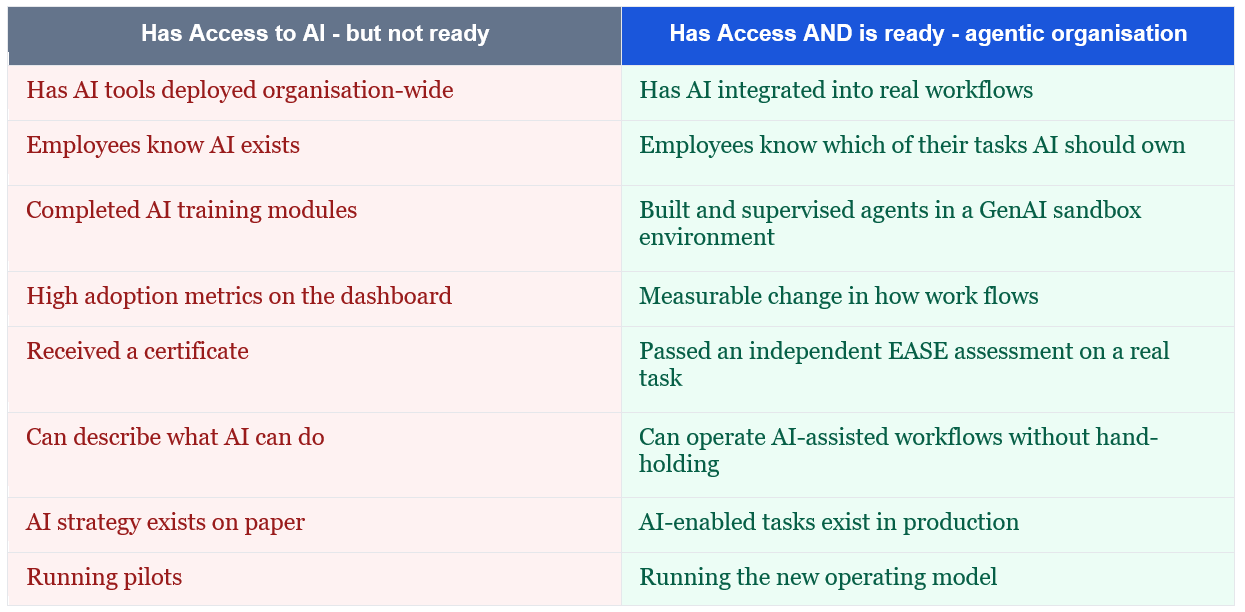
The right column is what becoming an agentic organisation actually looks like. Not a higher adoption score. Not more licences. A specific team operating a specific workflow differently with agents owning the tasks agents are good at, humans owning the tasks that require judgment, and defined handoff protocols for the transitions between them.
The shift from the left column to the right column is not achieved by deploying more AI tools. It is achieved by understanding the work first – task by task and then building the capability around what is actually changing.
The organisations widening the gap right now are not the ones with the most AI tools. They are the ones that mapped the work before training anyone, and built hands-on capability in a sandbox environment that mirrors production.
Why access alone does not create readiness
Understanding why access fails to produce readiness requires looking at three structural problems that no amount of AI tool deployment can fix.
Problem One: the work was never mapped
Access to AI means access to a general-purpose capability. Readiness requires knowing which specific tasks in a specific role that capability should touch. Two people with identical job titles at different companies may share only a third of their daily tasks. A generic AI tool, deployed without a task map, produces generic usage which is exactly what the 5 percent advanced-usage figure reflects.
This is why Task Intelligence comes before the AI Bootcamp. Before anyone enters a GenAI sandbox or configures an agent, Nuvepro runs a task-level audit of the real workflow. Every task is classified: automate (AI owns end-to-end), augment (human and AI together), or human-only (stays with the person). That classification is what makes the training specific rather than generic and specific training is what produces readiness.
Problem Two: training is designed for awareness, not operation
Most enterprise AI training programs are built to teach people what AI can do. Modules, videos, workshops, certifications – all designed to build comprehension. Comprehension is not operation. The person who understands how an agent works and the person who can configure one, integrate it with live systems, handle a handoff failure at 3pm on a Thursday, and supervise its output reliably without support – those are different people.
The only way to produce the second person is hands-on practice in an environment that mirrors the real work. This is the core principle behind the AI sandbox training platform model: you build the skill in the environment you will use it in, on data that looks like your data, on scenarios that look like your scenarios. Research on learning transfer is unambiguous on this point; skills learned in context transfer far more reliably than skills learned in abstraction.
Problem Three: success is measured by the wrong metric
Completion rates measure whether people attended. Satisfaction scores measure whether they enjoyed it. Neither measure whether anything changed about how they work. The Wharton GenAI Fast-Tracks into the Enterprise report (October 2025) found something instructive: despite nearly half of organisations reporting technical skill gaps, investment in training actually softened, and confidence in training as the primary path to capability is down 14 percentage points year-on-year.
Organisations are not losing faith in AI training. They are losing faith in training that cannot prove it worked. The EASE assessment in the Nuvepro AI Bootcamp is the answer to this problem: an independent, task-based assessment that proves the person can operate the new model without hand-holding. Not a quiz. A performance.
Wharton GenAI Fast-Tracks into the Enterprise Report – October 2025
Despite nearly half of organisations reporting technical skill gaps, investment in training has softened (-8pp) and confidence in training as the primary path to capability is down 14 percentage points year-on-year. Capability building is falling short of ambition. Organisations are not spending less on AI. They are spending it on tools and models, and skipping the workforce preparation that turns those investments into results.
The readiness spectrum: four stages, one destination
Readiness is not binary. Most enterprise teams exist somewhere on a spectrum between pure access and genuine project-readiness. Understanding where your team sits is the first step to closing the gap.
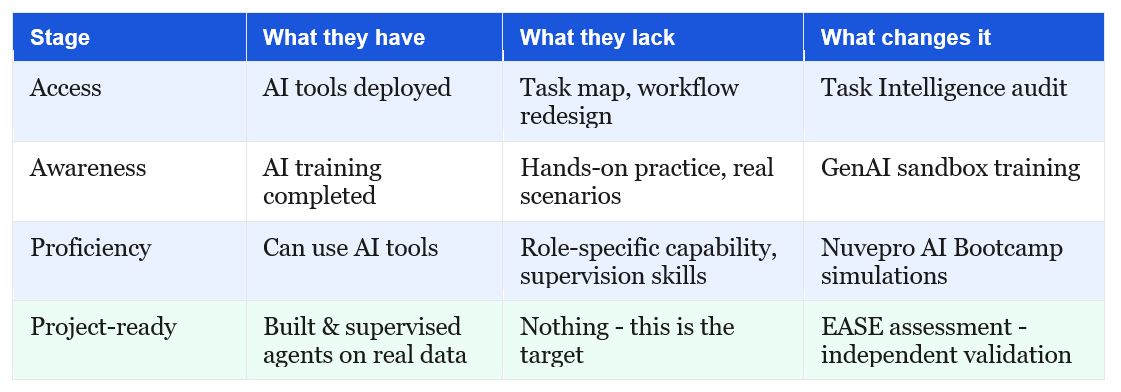
Most enterprise teams in 2026 sit at the Awareness stage – they have completed training and can use AI tools for low-stakes tasks. The move from Awareness to Proficiency requires role-specific, task-grounded generative AI training for employees built around what is actually changing in each person’s work. The move from Proficiency to Project-ready requires hands-on practice in a sandbox environment platform building agents on real data, integrating with real systems, and proving independent operation.
The destination is not Project-ready individuals. It is an agentic organisation where every key workflow has been redesigned around the human-AI split, every team member can operate the new model independently, and the organisation measures success not by adoption metrics but by tasks that are working differently.
How the AI Bootcamp closes the readiness gap in 14 days
The Nuvepro AI Bootcamp is designed specifically to move teams from Awareness to Project-ready in 14 days, for one real workflow. The structure has four phases:
Days 1-3: The Task Intelligence audit
Before any training begins, Nuvepro maps every task in the target workflow and classifies it as automate, augment, or human-only. This is the step that makes everything else specific. The audit tells the AI Specialist exactly which simulations to design. It tells leadership where the highest-impact opportunities are. And it tells each team member precisely what is changing in their role – so the training they receive is about their work, not AI in the abstract.
Days 3-5: The classification and the split
Leadership reviews the task classification before a single agent is built. This is not a rubber-stamp. It is a genuine decision about which tasks to hand to agents, which to redesign as human-AI collaboration, and which to protect as human-only. The three questions that guide this review: what is the actual economic value? What does this task teach? What happens to the person when it changes? Answering these questions before the build phase is what separates a thoughtful AI deployment from an automation audit.
Days 6-14: Build, integrate, stress-test, assess
This is where readiness is built. Three simulations per selected task, each four hours, each in a GenAI sandbox training platform built on your real workflow data. Simulation one builds the core agent. Simulation two integrates it with real systems. Simulation three stress-tests edge cases and practises the handoff protocols. Then the EASE assessment: four hours, independent, no AI Specialist present. Pass means project-ready.
By day 14, the first AI-enabled task is live in production. Not in a staging environment. Not awaiting approval. In production – built and operated by your team, validated by an independent assessment, running on the AI stack you already own.
Harvard Business School & BCG – 758 consultants, 2023
Professionals using AI on tasks inside their capability profile completed 25% more work, 25% faster, with 40% higher quality. The gains concentrated specifically where AI assisted human judgment rather than replacing it – the Augment bucket. Task Intelligence identifies this bucket before training begins. The bootcamp builds the capability to operate it.
What non-technical teams need to know
One of the most common questions we hear from enterprises considering the AI Bootcamp: our team doesn’t have a technical background. Can they still do this?
The answer is not just yes. It is that non-technical teams often produce the most durable bootcamp outcomes. The reason is straightforward: the simulations in the AI sandbox training platform are built as guided, step-by-step exercises. Your team does not need to write code. They need to understand the work – which is exactly what they already do.
The AI Specialist handles the technical setup. What the team handles is the workflow knowledge: where the edge cases are, what happens when the agent gets it wrong, which situations need human escalation, and how the handoff works in their specific context. That knowledge is the thing no model can provide. It is the institutional intelligence that makes agents reliable in production rather than reliable in a demo.
The enterprise skill training that works for non-technical teams is training built on what those teams know rather than what they don’t. Task Intelligence surfaces that knowledge. The bootcamp puts it to work.
EY found that 88% of employees use AI daily. But only 5% use it in ways that transform their work. The 83% in the middle are not held back by lack of access or lack of interest. They are held back by lack of a task map and lack of hands-on practice in a real environment.
The compound effect: from one workflow to an agentic organisation
A single bootcamp sprint is not the destination. It is the first step in a compounding process. Once one workflow has been redesigned, classified, and operated in the new model, the next workflow takes less time. The task classification database grows. The team’s confidence increases. The organisation’s ability to identify and deploy high-impact tasks accelerates.
Becoming an agentic organisation is not a single transformation initiative. It is a sequence of 14-day sprints, each one adding another workflow to the new model. The Pilot proves it works. The Sprint scales it. Department by department, the organisation moves from the left column of the access-vs-readiness table to the right one.
Gartner’s AI maturity roadmap maps this trajectory: task-specific agents (2026), collaborative multi-agent systems (2027), cross-app AI ecosystems (2028). By 2029, Gartner estimates half of knowledge workers will be building and managing agents. The organisations that will be ready are not the ones with the highest adoption metrics today. They are the ones systematically redesigning workflows now – one task-level sprint at a time.
Deloitte State of AI in the Enterprise, 2026
Two-thirds (66%) of organisations report productivity and efficiency gains from enterprise AI adoption. But more companies feel less prepared in terms of infrastructure, data, risk, and talent – even as their strategy confidence grows. Worker access to AI rose 50% in 2025, yet the gap between access and genuine workforce readiness has not closed. The number of companies scaling AI to production is set to double in six months. The enterprises not ready by then will feel it.
Readiness is not a state. It is a practice.
Access to AI was the challenge of 2023 and 2024. Readiness is the challenge of 2026 and beyond. And readiness is not a one-time achievement. AI capabilities evolve every six months. New tools arrive. The task classifications that are accurate today will need revisiting. The teams that are project-ready today will need to extend that readiness to the next workflow, the next department, the next generation of agents.
This is why the AI Bootcamp is not positioned as a training programme. It is positioned as the operational mechanism for building and maintaining readiness – sprint by sprint, workflow by workflow, until the organisation is genuinely agentic rather than just AI-enabled.
The distance between having AI tools and knowing how to use them is not measured in months of training. It is measured in one real workflow, redesigned at the task level, built by your team in a live AI sandbox training platform, and running in production by day 14.
That is what readiness looks like. And it is the only version of it that shows up on the balance sheet.
“Access is universal. Readiness is rare. The AI Bootcamp is how enterprises close the distance between the two.”
Find out where your team sits on the readiness spectrum.
Nuvepro’s Task Intelligence audit classifies every task in your workflow as automate, augment, or human-only - and shows you exactly what your team needs to learn before they need to learn it. The AI Bootcamp then builds the capability in a GenAI sandbox environment on your real workflow data. First agent live in production in 14 days.