

Every labour economist, every AI researcher, every podcast guest talking about the future of work says the same thing: AI doesn’t replace jobs, it takes over tasks. Jobs are bundles of tasks. Workflows are sequences of them. The only way to understand what AI actually changes inside your organisation, inside your team is to go to the task level. That’s not a new idea. It’s what the research has said for over a decade. Task Intelligence is what finally makes it operational.
Turn on any economics podcast right now and you will hear a version of the same argument. It might come from David Autor at MIT, from the Daron Acemoglu lecture series, from a Goldman Sachs research note, from a Wharton report on generative AI in the enterprise. The specific framing varies. The underlying insight is identical: AI does not walk up to a job and take it. It picks off specific tasks from inside the job, one at a time.
This has been the core finding of labour economics research since at least 2013, when Frey and Osborne decomposed 702 US occupations into their constituent tasks and concluded that 47 percent of jobs face high automation risk but only when you look at the task level. Not the job. Not the title. The task.
More than a decade later, most enterprise AI deployments still have not internalised this. They deploy tools to job titles. They run training programmes for departments. They ask whether AI can ‘do’ a role. They are operating at the wrong level of abstraction – and the ROI shows it.
Task Intelligence is what happens when you take the economist’s insight seriously inside a real organisation. It is the systematic classification of every task in a job or workflow as automate, augment, or human-only. It is the data layer that makes AI transformation specific rather than generic. It is, in the words of the research that underpins it, the only level at which AI’s impact can be understood and shaped.
“Every economist talking about AI and jobs says the same thing: it’s taking tasks, not jobs. Task Intelligence is the framework that operationalises that insight inside your enterprise.”
What every economist is actually saying and what it means
The academic consensus on AI and work is unusually clear for a field that usually argues about everything. Across MIT, Oxford, Harvard, Goldman Sachs, and the World Economic Forum, the same framework keeps appearing.
David Autor – Ford Professor of Economics, MIT · MIT FutureTech Conference 2025 & CSAIL Alliances Podcast 2026
“Jobs actually involve bundles of tasks, some of which require more expertise than others. You should care about what part of the bundle is being done by the machine, and what part remains for you. AI’s impact on employment depends on which tasks within a job it automates – not whether it can handle the job as a whole.”
Autor’s point is precise and important. When a task inside a job gets automated, what remains is not a smaller version of the same job. It is a fundamentally different configuration of work – one that may require new skills, carry different responsibilities, and create different kinds of value. The job title on the org chart may stay the same. The work inside it changes entirely.
MIT FutureTech Research – March 2026 · Crashing Waves vs Rising Tides: AI Automation of 3,000+ O*NET Tasks
“AI automation is a rising tide across a wide range of tasks – broad and continuous rather than concentrated on specific jobs. AI models successfully complete tasks that take humans approximately 3-4 hours with 50% success rate in 2024, rising to 65% by 2025-Q3. If trends continue, LLMs will complete most text-related tasks with 80-95% success rates by 2029.”
Read that carefully. The research is not saying AI will take specific jobs by 2029. It is saying AI will complete most text-based tasks with high success rates. The jobs that contain those tasks will change. The extent to which any individual is affected depends entirely on what their specific job’s task bundle looks like – how many of their tasks are text-based and LLM-addressable, how many require physical presence, how many depend on judgment that no model can replicate.
OpenAI Research – GPTs are GPTs, 2023 · Eloundou, Manning, Mishkin, Rock – the most cited AI-labour paper of the decade
“Considering each job as a bundle of tasks, it would be rare to find any occupation for which AI tools could do nearly all of the work. Exposure to AI at the task level tends to be diversified within any occupation. Both automation and augmentation exposures tend to be positively correlated.”
Three of the most important research voices in this space – MIT FutureTech, David Autor, and OpenAI’s own economists – all pointing to the same unit of analysis. Not the job. The task. And all reaching the same conclusion: you cannot understand AI’s impact on work until you have decomposed the work into its tasks.
48%
of US jobs face high automation risk – but only when analysed at the task level (Frey & Osborne, Oxford, 2013)
80%
of workers have at least 10% of tasks exposed to LLMs (OpenAI, 2023)
49%
of jobs saw Claude used for at least a quarter of their tasks by Nov 2025 (Anthropic Economic Index)
80-95%
AI success rate on most text-related tasks projected by 2029 (MIT FutureTech, 2026)
The two equations at the heart of Task Intelligence
If you take the economist’s framework seriously, two equations emerge that should govern every enterprise AI decision. They are not complicated. But they are almost universally ignored in the way enterprises actually plan and deploy AI.

These two equations change everything about how you approach AI transformation. If a job is a bundle of tasks, then the question ‘will AI replace this job?’ is the wrong question. The right question is: ‘which tasks inside this job will AI own, which will it assist with, and which will the person keep?’
If a workflow is a sequence of tasks, then the question ‘can AI do this process?’ is also wrong. The right question is: ‘task by task, what changes inside this process, what gets handed to an agent, what stays with a human, and where are the handoff points?’
Task Intelligence operationalises both equations. It decomposes every job into its actual tasks using eight parallel data sources – including Department of Labor occupational data and real job postings from 2,400+ companies. It maps every workflow at the task level. And then it classifies each task: automate, augment, or human-only. That classification is the data layer that makes every subsequent AI decision – deployment, training, redesign, measurement – specific rather than generic.
The moment you accept that jobs are bundles of tasks and workflows are sequences of them, the entire AI transformation question changes from ‘are we AI-ready?’ to ‘which specific tasks are we redesigning, and what does each person’s role look like after?’
The 30/40/30 pattern - what task classification consistently reveals
When Nuvepro’s Task Intelligence platform classified 1.25 million tasks across 81 industries and 894 occupations, a pattern emerged with striking consistency. It held in financial services, healthcare, manufacturing, and technology. The same rough split appeared regardless of industry.
AUTOMATE
30%
AI owns end-to-end. Data checks, report generation, scheduling, format matching. Agents deployed here first.
AUGMENT – HIGHEST ROI
40%
Human + AI together. AI handles 70-80% of the work. Person reviews, adjusts, makes the call. Most value lives here.
30%
HUMAN ONLY
Judgment under uncertainty. Empathy. Relationships. Ethical calls. Creative synthesis. Irreducibly human.
The 40 percent augmentation bucket is the most important finding in this data – and it is the one that most enterprise AI strategies miss entirely. The Harvard/BCG study of 758 consultants confirmed what this split implies: AI made professionals 25 percent faster and 40 percent better in output quality specifically on tasks where AI assisted human judgment. Not on fully automated tasks. On augmented ones. The Augment bucket is where most enterprise AI value actually lives.
But the split looks dramatically different from one role to the next. A bookkeeping clerk sits at 78 percent AI-readiness. A nursing assistant sits at 16 percent. That is a 62-point gap within the same economy. Broad organisational statements about ‘AI readiness’ are almost meaningless. The only number that matters is the task-level breakdown for each specific role in each specific organisation.
This is also what Anthropic’s Economic Index found in November 2025: 49 percent of jobs saw their AI being used for at least a quarter of their tasks. But once you account for success rates – how often the AI actually completed the task well – the picture shifts. Some roles are far more affected than task coverage alone suggests. Some far less. The boundary between AI-ready and human-only is not where the job title implies it is. It is where the task classification puts it.
What most enterprises do instead and why it fails
Understanding why most enterprise AI deployments underdeliver requires seeing the gap between what the economics says and what organisations actually do.
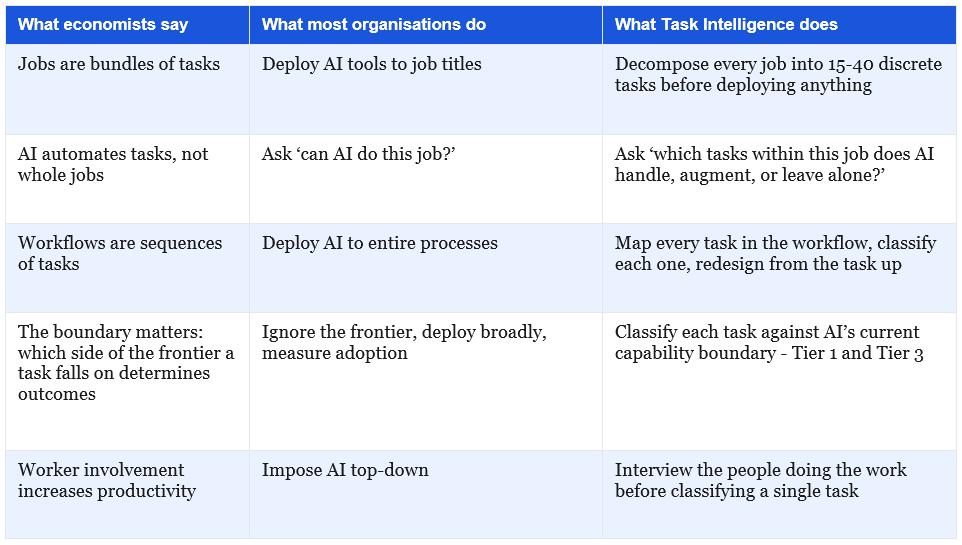
The left column is what every economist, every podcast, every labour market research paper says. The middle column is what most enterprises do when they hear it. The right column is what Task Intelligence actually delivers.
The gap between the middle and right columns is where enterprise AI ROI disappears. A 2025 MIT survey found that 95 percent of generative AI pilots fail to deliver measurable P&L impact. That failure rate is not a technology problem. It is a level-of-abstraction problem. Organisations are deploying at the job level and measuring at the department level when the real unit of analysis – the task – is being ignored entirely.
Dallas Federal Reserve – February 2026 · AI Simultaneously Aiding and Replacing Workers
“Automation innovations substitute for workers while augmentation innovations complement worker expertise. Autor and Thompson model jobs as bundles of tasks. The same technological innovation might automate the expert components of one job while augmenting the expertise in another. The outcome for any worker depends entirely on which tasks within their bundle the technology touches.”
Why workflows are the practical unit and tasks are the analytical unit
There is an important distinction between how Task Intelligence is deployed and how it is analysed.
Analytically, the task is the unit. Every insight in the economics research, every classification, every ROI calculation happens at the task level. A task has a name, a description, a time cost, a cognitive profile, and a position on the automate-augment-human spectrum. The task is where the AI capability boundary runs.
But practically, the workflow is the unit of deployment. Nobody redesigns a single isolated task. They redesign the workflow that contains it because workflows are how work actually flows through an organisation. A change to one task in a workflow affects the tasks around it. The handoff from an automated task to an augmented one needs to be designed. The moment a task moves from human to agent, the adjacent tasks may change in what they require.
This is why the Nuvepro AI Bootcamp is structured around workflows, not tasks in isolation. The Task Intelligence audit maps and classifies every task within a chosen workflow. The agent build happens within that workflow context. The simulations are built on the real workflow data. And the deployment on day 14 is a workflow running differently not a single task floating free of its context.
Task Intelligence is the analytical layer. The workflow is the deployment layer. The job is what changes as a result. All three levels exist and matter – but the task is where every decision gets made.
The three questions Task Intelligence forces enterprises to answer
Taking the task-level framework seriously means confronting three questions that most enterprise AI strategies never ask. They are not comfortable questions. But they are the only questions that produce answers worth acting on.
01 – What does this person actually do?
Not their job title. Not their job description. Their actual work, on a normal Tuesday, broken into the discrete things they do between 9am and 5pm. Two people with the same title at different companies may share only a third of their tasks. Until you have asked the question and documented the answer, you are deploying AI to a label rather than to the work.
This is why the Task Intelligence audit starts with interviews – with the people doing the work. Not with the org chart. Not with the job description database. With the actual humans who can tell you what the edge cases are, what the workflow really looks like when data is messy, and which tasks are harder than they appear on paper.
02 – Which side of the frontier is each task on?
The Harvard/BCG ‘Jagged Frontier’ research named the most important concept in enterprise AI deployment: AI capability is uneven and unpredictable. It is excellent at some tasks and actively harmful at others, with no clean boundary visible from the job level. Professionals using AI on tasks inside the frontier improved by 12-40 percent. On tasks outside it, they performed 19 percentage points worse.
Without task-level classification, you do not know which side of the frontier your team is deploying on. You can be making your people faster on the tasks AI is good at while simultaneously making them worse on the tasks that matter most. The classification is not a nice-to-have. It is the protection against net-negative deployment.
03 – What do people do with the time that gets freed?
This is the question that determines whether AI transformation produces value or destroys it. David Autor’s research is clear: automation that frees people to do higher-value work increases their wage premium. Automation that leaves people with fragmented, low-engagement work – or no work at all – does the opposite.
Task Intelligence does not just classify tasks for automation. It answers the question: if these tasks move to an agent, what does the person now have time for? What does the redesigned role look like? What new skills does it require? This is what makes Task Intelligence different from an automation audit. It is not just about what AI can do. It is about what the work should look like after.
How Task Intelligence builds toward an agentic organisation
The economist’s framework - jobs as bundles of tasks, workflows as sequences of them - points to what an agentic organisation actually is: one where the task-level split between human work and agent work has been defined explicitly, designed deliberately, and deployed in production.
Not an organisation that uses AI tools. Not an organisation where people have completed AI training. An organisation where specific tasks have been classified, specific agents have been built to own the automatable ones, specific handoff protocols define where agents pass work to humans, and specific people are trained to supervise, adjust, and improve the agents over time.
Becoming an agentic organisation is not a transformation programme. It is a sequence of task-level decisions, made workflow by workflow, that compound over time. The first sprint proves the model works. The second is faster than the first. By the fifth, the organisation has a classification database, a team of people who know how to operate the new model, and a pattern of workflow redesign that has become a competitive capability.
Every economist studying AI and work has been pointing to this framework for over a decade. Task Intelligence is what makes it operational – not as a research exercise, but as a 14-day sprint that ends with something live in production.
“Jobs are bundles of tasks. Workflows are sequences of them. Task Intelligence is the framework that takes those equations seriously inside a real enterprise.”